
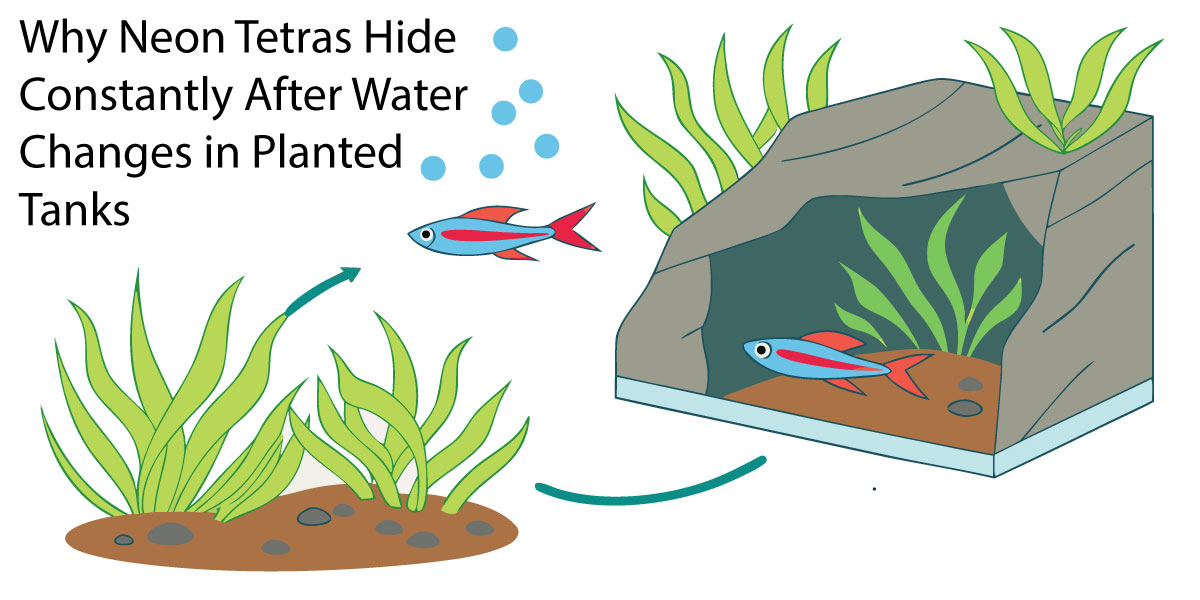
Neon tetras are among the most popular schooling fish in planted aquariums due to their vibrant blue and red coloration and peaceful nature. However, many aquarists notice a troubling behavior pattern: neon tetras suddenly hiding for hours or even days after water changes, especially in planted tanks.
This behavior often alarms fishkeepers, leading to concerns about illness, aggression, or poor tank health. In reality, post–water change hiding is usually a stress response, not a disease—and planted tanks introduce specific variables that intensify this reaction.
This article explains why neon tetras hide constantly after water changes in planted tanks, what environmental triggers cause this behavior, and how to adjust maintenance routines to keep your tetras calm, active, and visible.
Understanding Normal Neon Tetra Behavior
Neon tetras (Paracheirodon innesi) are:
- Small schooling fish
- Naturally timid
- Adapted to shaded, slow-moving waters
- Dependent on group security
In the wild, they live in blackwater streams with stable chemistry, minimal flow, and dense plant cover. Any sudden environmental change can trigger hiding as a survival instinct.
Why Planted Tanks Intensify Post–Water Change Stress
Planted tanks are beneficial, but they also create unique chemical and physical dynamics:
- Active substrates alter water chemistry
- Decomposing plant matter affects ammonia levels
- CO₂ and fertilizers change dissolved gas balance
- Dense planting limits escape routes
When combined with water changes, these factors can overwhelm sensitive species like neon tetras.
Main Reasons Neon Tetras Hide After Water Changes
1. Sudden Changes in Water Chemistry
Even “safe” water changes can cause rapid shifts in:
- pH
- Temperature
- Hardness (GH/KH)
- Total dissolved solids (TDS)
Neon tetras are especially sensitive to rapid parameter swings, even when values remain within acceptable ranges.
In planted tanks, active soils and fertilizers can amplify these changes.
2. Temperature Mismatch During Water Changes
Temperature differences of just 1–2°F (0.5–1°C) can stress neon tetras.
Cold replacement water causes:
- Metabolic shock
- Reduced swimming confidence
- Immediate hiding behavior
Planted tanks often mask temperature differences due to slower circulation.
3. Disturbance of Plant Cover and Territory
Water changes often involve:
- Gravel vacuuming
- Plant trimming
- Equipment movement
This disrupts:
- Established hiding zones
- Visual barriers
- Schooling pathways
Neon tetras retreat until they re-evaluate safety.
4. Increased Water Flow and Turbulence
After water changes:
- Filters run stronger
- Surface agitation increases
- CO₂ off-gassing accelerates
Neon tetras prefer gentle, predictable flow. Sudden current changes make them feel exposed and vulnerable.
5. Stress from Light Changes
Many aquarists turn lights on immediately after maintenance.
Bright lighting following:
- Physical disturbance
- Chemical shifts
- Increased visibility
Triggers a natural fear response. In the wild, neons avoid bright, open water after disruption.
6. Chlorine or Chloramine Exposure (Even in Small Amounts)
Incomplete dechlorination can cause:
- Gill irritation
- Oxygen uptake problems
- Disorientation
Planted tanks may hide symptoms because plants absorb some toxins—but fish still react behaviorally.
7. Micro-Ammonia Spikes from Substrate Disturbance
Disturbing substrate releases:
- Trapped organic waste
- Ammonia pockets
- Anaerobic byproducts
Neon tetras detect these changes instantly and retreat to safety.
8. School Size and Confidence Issues
Small schools (fewer than 6 neons):
- Feel less secure
- Hide more frequently
- Take longer to resume activity
After water changes, this insecurity becomes more pronounced.
Is Hiding After Water Changes Dangerous?
In most cases, no.
Temporary hiding (a few hours) is normal. However, concern is warranted if:
- Hiding lasts longer than 48 hours
- Fish refuse food
- Colors appear faded
- Rapid gill movement is visible
These signs indicate prolonged stress or water quality issues.
How to Prevent Neon Tetras from Hiding After Water Changes
1. Match Water Parameters Precisely
Before adding water:
- Match temperature exactly
- Use similar hardness and pH
- Avoid large chemistry corrections during changes
Consistency matters more than “perfect” numbers.
2. Reduce Water Change Volume
In planted tanks:
- 20–25% weekly changes are ideal
- Avoid 50%+ unless necessary
Smaller, frequent changes reduce shock.
3. Slow the Refill Process
Add water:
- Slowly
- Gently
- Using a diffuser or plate
This prevents sudden pressure and flow changes.
4. Dim Lights After Maintenance
- Keep lights off for 2–4 hours post-change
- Gradually return to normal photoperiod
This mimics natural recovery conditions.
5. Maintain Stable Plant Layouts
- Avoid excessive rearranging
- Trim gradually
- Preserve known hiding zones
Predictability increases fish confidence.
6. Improve Oxygen Stability
- Ensure gentle surface movement
- Avoid over-heating
- Maintain clean filters
Stable oxygen levels reduce stress responses.
7. Increase School Size (If Tank Allows)
A group of 8–12 neon tetras:
- Displays more confidently
- Recovers faster from disturbances
- Hides less after maintenance
Common Mistakes Aquarists Make
- Over-cleaning planted tanks
- Large, infrequent water changes
- Ignoring temperature precision
- Turning lights on immediately
- Assuming hiding equals disease
These mistakes unintentionally train fish to fear maintenance.
FAQs
Q1: How long should neon tetras hide after a water change?
Typically 1–6 hours. Up to 24 hours can be normal in sensitive tanks.
Q2: Does hiding mean my neon tetras are sick?
Not usually. If appetite and color return, the behavior is stress-related.
Q3: Are planted tanks bad for neon tetras?
No. Planted tanks are ideal when maintained gently and consistently.
Q4: Should I skip water changes to avoid stress?
No. Poor water quality causes far more stress than gentle water changes.
Q5: Will neon tetras stop hiding over time?
Yes. As tanks mature and routines stabilize, hiding behavior decreases significantly.
Conclusion
When neon tetras hide constantly after water changes in planted tanks, the cause is almost always environmental stress—not illness. Sudden changes in water chemistry, temperature, flow, and lighting trigger a natural survival response in this sensitive species.
By refining water-change techniques, maintaining parameter consistency, and minimizing disruption, aquarists can dramatically reduce hiding behavior. A calm, predictable environment allows neon tetras to display their full color, schooling beauty, and natural activity—even immediately after maintenance.
References
- Axelrod, H. R. (2018). Encyclopedia of Tropical Fishes.
- Andrews, C. (2013). Tetras and Their Care. Interpet Publishing.
- Walstad, D. (2013). Ecology of the Planted Aquarium.
- Aquarium Co-Op Research — Tetra Behavior & Stress Responses.
- Aquatic Plant Central (APC) — Planted Tank Maintenance Studies.
- University of Florida IFAS — Freshwater Fish Stress Physiology.