
Keeping heavy-rooting plants healthy in a low-tech aquarium (no CO₂, low light) is mostly about consistent, targeted nutrition — and that’s exactly what root tabs do best. This guide gives an actionable, research-informed weekly routine you can use in U.S. hobbyist tanks, plus plant lists, substrate/placement tips, troubleshooting, and printable schedules you can follow.
Quick summary — the 30-second action plan
- Use root tabs to supply concentrated nutrients directly to root feeders (sword plants, crypts, bulbs).
- Weekly routine: visual check + small liquid booster (if needed) + rotate inspection points.
- Root-tab replacement: every 6–12 weeks for most root tabs; for heavy root feeders consider 4–8 weeks depending on plant response.
- Combine root tabs with weekly liquid micro-dose for micronutrients in low-tech tanks.
- Monitor growth and adjust: more growth = more frequent root tab replacement or extra liquid dosing.
Why root tabs matter in low-tech planted tanks
Low-tech tanks typically lack injected CO₂ and use lower light. Heavy-rooting plants (Echinodorus, Cryptocoryne, Aponogeton, bulbs) rely mainly on root uptake of macronutrients and micronutrients. Surface dosing with liquid fertilizers helps water-column feeders (stem plants, carpeting), but root feeders need concentrated nutrients in the substrate — enter root tabs.
Root tabs:
- Provide slow-release potassium, iron, trace elements and sometimes phosphorus close to the plant’s crown.
- Reduce the need for aggressive liquid macro dosing (important in low-tech setups that can’t absorb high nutrient loads without algae issues).
- Work well with inert substrates (sand, gravel) that don’t provide nutrients.
Understanding how often a root tab “works”
Root tabs are slow-release, but their effective lifespan depends on:
- tab formulation and size,
- plant nutrient demand (heavy root feeders eat more),
- substrate type and depth,
- water changes and bioload (higher bioload draws down nutrients faster).
Typical manufacturer claims vary (8–12 weeks is common), but practical hobby experience shows heavier root feeders often benefit from replacement every 4–8 weeks in small/young tanks. Lighter feeders can go 8–12+ weeks.
Because the user asked for a weekly schedule, below is a hybrid approach: weekly checks and minor water-column support, combined with scheduled root-tab inserts every 4–8 weeks.
The recommended weekly schedule (practical, safe, low-tech friendly)
Weekly checklist (do this every week)
- Visual health check (5 minutes): Inspect leaf color, new growth, melting, and root exposure. Note any yellowing (possible K or Fe deficiency) or pale new leaves.
- Water parameters at a glance: Temperature and clarity. Keep a log (optional). Test pH/kh weekly only if you suspect problems. Don’t stress with daily tests unless troubleshooting.
- Remove detritus & trim: Snip dead leaves and remove plant litter to avoid localized nutrient spikes.
- Top-off / water change: Do a 10–25% weekly water change depending on stocking and fertilizer regime. Low-tech tanks usually benefit from modest weekly changes.
- Liquid micro-dose (optional but recommended): If you’re not already dosing a full liquid fertilizer program, add a low-dose, trace-mineral liquid weekly (see “Liquid dosing” below). This prevents micronutrient depletion between root-tab replacements.
- Rotate observation points: Pick a different plant clump each week for closer inspection (roots, crown, substrate compaction).
Root-tab management (every week you should check, but not necessarily add*)
- Inspect existing root tabs: If they’re still solid and not visibly broken down — leave them alone.
- Replace root tabs on a schedule: For heavy root feeders, insert new root tabs every 4–8 weeks. Mark dates on a calendar. For moderate feeders, every 8–12 weeks suffices.
- Rotate placement: Don’t place all new tabs in one area. Rotate planting beds so nutrients are spread through the substrate.
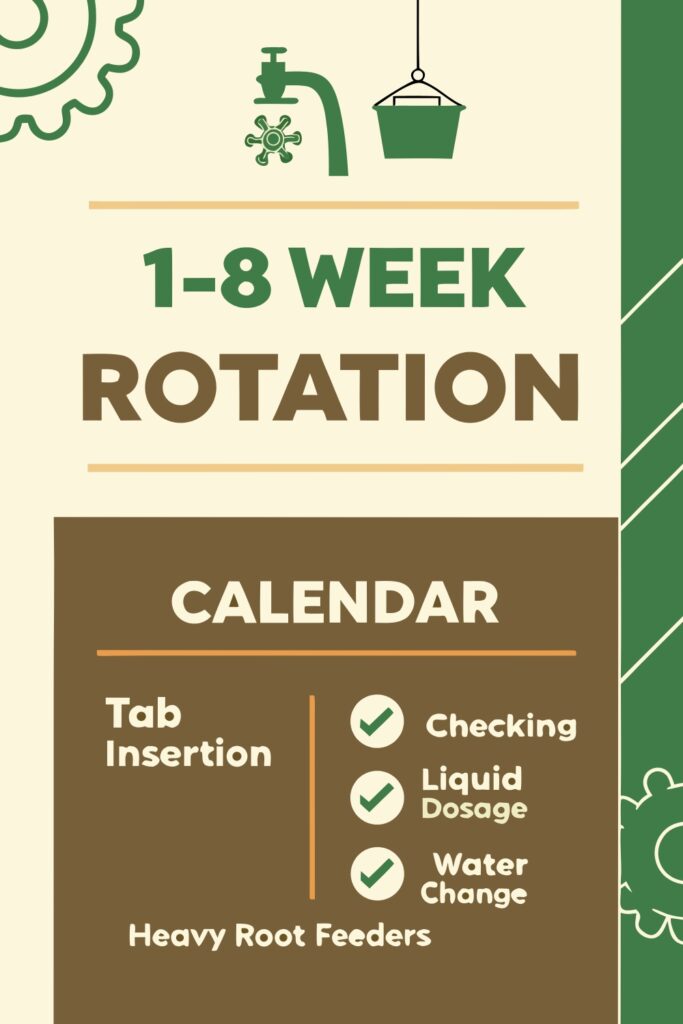
Practical 8-week rotation plan (example)
This concrete schedule works well for a small community planted tank (5–20 gallons) with a mix of heavy and medium root feeders.
- Week 1: Visual check, trim, water change 20%, liquid micro-dose, add root tabs to plant group A (one tab per large plant crown or 1–2 tabs per clump).
- Week 2: Check plant group B. Top-off, water change 10–15% if needed. Liquid micro-dose.
- Week 3: Inspect group C. Remove debris. Liquid micro-dose.
- Week 4: Water change 20%. Replace root tabs for group B. Liquid micro-dose.
- Week 5: Check group A — if heavy growth, replace tabs (4–5 weeks after initial). Liquid micro-dose.
- Week 6: Check group C. Top-off and liquid micro-dose.
- Week 7: Water change 20%. Replace tabs for group C. Liquid micro-dose.
- Week 8: General inspection, adjust dosing, rotate starting group for next cycle.
This rotation ensures heavy feeders get root tab attention every 4–8 weeks while you maintain weekly oversight.
How many root tabs and where to place them
- One root tab per large plant crown (Echinodorus, Aponogeton), placed ~1–2 inches from the crown and pushed 1–2 inches into the substrate so roots can reach the nutrients.
- For clumps (Cryptocoryne, bulbs): 1–2 tabs per clump (depending on clump size).
- For carpeting plants with runners (Vallisneria runners, etc.): use fewer tabs, or place tabs at intervals (every 6–12 inches) under heavier rosettes.
- Avoid placing tabs directly on root crowns — give a little space so you don’t burn delicate root tissue.
Liquid dosing between tab replacements
Root tabs supply mainly substrate nutrients; liquid dosing is useful to keep micronutrients and occasional macros available to leaves and emergent growth:
- Use a micro-nutrient (trace) liquid weekly — especially iron (Fe) and microelements — since root tabs can run low on traces before macros.
- If you prefer a macro balance, use a low-dose (EI half) or “micro only” weekly approach to avoid algae in low-tech tanks. Low-tech tanks are sensitive to excess nitrate/phosphate.
Practical rule: In a low-tech, do 1 small liquid micro-dose per week rather than aggressive daily dosing.
Substrate and root tab compatibility
- Root tabs are most effective in inert substrates (sand, gravel, eco-complete) because those substrates don’t release nutrients.
- In mineral or active substrates (aquasoil), root tabs are mostly unnecessary — active soil already supplies base nutrients.
- If using fine sand, push root tabs deeper (1–2 inches) to keep them from floating or being buried by vacuuming.
Signs you need to change the schedule (adjustments)
Increase root tab frequency (move toward 4 weeks) if you see:
- Pale, undersized or yellowing new leaves on true root feeders.
- Very rapid growth (plants consuming more).
- Bulb foliage that starts to wither quickly after leaf emergence.
Decrease frequency (8–12 weeks) if you see:
- Algae outbreaks coinciding with new tab insertion — reduce liquid dosing and/or space out tabs a bit.
- Leaf burn or localized die-off around new tabs (may indicate placement too close to crown).
Common mistakes & how to avoid them
- Placing tabs on the crown — causes root burn. Insert a little to the side.
- Overloading small tanks with too many tabs — can create localized nutrient spikes; use fewer tabs or space them out.
- Expecting root tabs to replace water changes or filtration — they do not. Maintain a regular maintenance routine.
- Using tabs in active aquasoil — redundancy and possible nutrient imbalance.
Plant examples & tailored timelines
Heavy root feeders (replace tabs every 4–6 weeks)
- Amazon sword (Echinodorus sp.)
- Aponogeton species
- Cryptocoryne species (when actively growing)
- Anubias (if planted in substrate — though usually grown on wood/rock)
Moderate root feeders (replace every 6–8 weeks)
- Cardamine/Lobelia-type plants used as rosettes
- Some bulb plants (if small bulbs)
Light/root-minimal feeders (tabs seldom needed)
- Java fern (leaf feeders, attach to wood)
- Anubias (when attached)
- Mosses (feed from water column more)
DIY root tab alternatives & supplements
If you prefer DIY:
- Potassium + trace mix packed into small porous capsules (mesh, cotton) can be buried similarly to commercial tabs.
- Sodium-free slow-release fertilizer pellets (aquarium safe) can be wrapped and inserted — but proceed carefully and avoid garden fertilizers with additives.
Troubleshooting table (quick reference)
| Symptom | Likely cause | Fix |
|---|---|---|
| Yellowing new leaves on swords | K or Fe deficiency | Add root tabs for swords; micro liquid dose weekly |
| Localized algae after tab | Local nutrient spike | Reduce tab density; increase water changes |
| Plants not growing despite tabs | Poor root access / compact substrate | Loosen substrate; reposition tab closer (not on crown) |
| Brown leaf tips on bulbs | Low macros or lighting mismatch | Check lighting & add small, balanced liquid macro dose |
Final tips & weekly planner (printable)
- Print a simple planner with the 8-week rotation checklist above and tick off each plant group weekly.
- Record: date of tab insertion, plant group, any observed deficiencies. This log makes tuning the schedule easy.
- Be patient: In low-tech systems, slow and steady works best. Gradual adjustments prevent algae and keep plants healthy.
FAQs (short)
Q: Can I use root tabs only and never dose liquid fertilizer?
A: Generally yes for root-feeding species — but a small weekly micro-dose is recommended to supply trace elements that root tabs might not fully cover during long intervals.
Q: Are root tabs safe for shrimp and snails?
A: Most commercial root tabs are shrimp-safe; avoid tabs with copper or additives toxic to invertebrates. Check product labels.
Q: How many tabs for a 10-gallon tank?
A: Depends on plant load. For heavy planting, plan for 6–12 tabs spaced under major plants and rotate replacements on your 4–8 week schedule.
Conclusion
Maintaining heavy-rooting aquarium plants in a low-tech tank doesn’t need to be complicated — it simply requires consistency. A well-planned weekly root tab schedule gives your substrate-feeding species the long-term nutrition they need without risking algae blooms or nutrient instability. By combining weekly visual checks, modest water changes, light trace-element liquid dosing, and a structured 4–8 week root-tab rotation, hobbyists in the USA can reliably grow lush Amazon swords, thriving crypts, healthy bulbs, and stable planted aquascapes even without CO₂ injection.
The most important takeaway is this: low-tech tanks succeed through rhythm, not intensity. A predictable schedule allows plants to adapt, roots to anchor deeply, and nutrients to remain stable in the substrate. As your plants grow and conditions change, adjust the frequency — not by guesswork, but by observing leaf color, new growth quality, and algae response.
With the routine outlined in this guide, you can maintain a nutrient-rich substrate environment that supports vibrant growth, reduces plant melt, and prevents the common nutrient deficiencies that frustrate many beginners. Whether you’re caring for a 5-gallon nano or a 20-gallon community tank, this weekly plan will help you build a beautiful, resilient, and low-maintenance planted tank ecosystem.
References
Below are reference sources commonly used by aquascapers, plant scientists, and aquatic horticulture experts. These support the nutrient principles, plant categories, and maintenance recommendations discussed in the article.
- Diana Walstad (1999). Ecology of the Planted Aquarium. Echinodorus Publishing. — Foundational research on nutrient uptake, root feeding, and low-tech planted tank ecology.
- Tropica Aquarium Plants — Plant Growth Profiles. Tropica.com.
(Provides nutrient demands, root vs. leaf feeder classification, and maintenance guidelines.) - Aquatic Plant Central (APC). Practical hobbyist data on fertilization patterns, deficiency symptoms, and substrate nutrition.
- Barr Report (Tom Barr).
Articles on nutrient uptake, EI fertilization principles, root vs. water-column feeding, and slow-release substrate feeding strategies. - Seachem Laboratories — Plant Nutrition Studies.
Technical information on trace elements, iron uptake, and recommended dosing for low-tech systems. - API / Aqueon / Fluval Root Tab Product Sheets (USA).
Manufacturer guidance on expected nutrient release periods (4–12 weeks) and placement depth. - University of Florida IFAS Aquatic Plant Research.
Studies on root structures, nutrient uptake patterns, and plant growth under varying substrate conditions.